
Body checking after cancer — the repeated monitoring of physical sensations for signs of recurrence — is one of the most common behavioural expressions of fear of cancer recurrence (FCR). Research shows that around 50–60 per cent of cancer survivors experience at least moderate levels of FCR (Luigjes-Huizer, Tauber et al., 2022), and cognitive-behavioural models identify behaviours such as body checking and symptom monitoring as key maintaining processes that can reinforce and prolong the fear response over time rather than allowing it to resolve (Lee-Jones et al., 1997; Wells & Matthews, 1994; Butow et al., 2017; Tauber et al., 2023). The cycle works through negative reinforcement: checking produces brief relief, which strengthens the urge to check again, which keeps the threat detection system in a state of heightened alert. Evidence-based psychological approaches — particularly Acceptance and Commitment Therapy (ACT) — can help people step out of the checking loop by changing how they relate to bodily sensations rather than trying to eliminate the sensations themselves (Tauber et al., 2019; Yuyan et al., 2025).
You notice it before you even realise what you are doing.
Your hand moves to a spot on your body — your neck, your chest, your abdomen — and presses. You are feeling for something. A lump, a change, a hardness that was not there before. You may do it in the shower, in bed at night, in the middle of a meeting. Sometimes you catch yourself mid-check and stop. Sometimes you do not catch yourself at all.
If this is familiar, you are not imagining things, and you are not being irrational. Body checking after cancer is one of the most common and least talked-about experiences in survivorship. It is driven by something real — the knowledge that your body has already produced a threat once before — and it follows a logic that makes complete sense from the inside.
The difficulty is that the logic leads somewhere unhelpful. The more you check, the more you need to check. And the more you check, the harder it becomes to trust your own body again.
What body checking actually is
Body checking is the repeated monitoring of your body for signs that cancer may have returned. It can take many forms: pressing or prodding a specific area, running your fingers along tissue where a tumour once was, standing in front of a mirror looking for changes, tracking your energy levels or weight with anxious attention, or mentally scanning your body for anything that feels different.
Some people check the same spot dozens of times a day. Others have a ritual — a morning check, an evening check, a check triggered by a specific sensation. Some check constantly but so automatically that they barely notice they are doing it. It becomes part of the background noise of their day.
Body checking is not the same as appropriate self-monitoring. Most cancer follow-up guidelines encourage people to be aware of new or persistent symptoms and to report them to their medical team. That is reasonable, proportionate vigilance. Body checking is something different: it is driven by anxiety rather than information, and it does not end with a conclusion. It ends with temporary relief — and then starts again.
Why the checking starts
To understand body checking, it helps to understand what cancer does to your relationship with your body. Before cancer, most people live with an unspoken assumption: my body is basically safe. Sensations come and go — a headache, a muscle ache, a twinge — and they pass without meaning. You do not interpret them. You barely notice them.
Cancer breaks this assumption. You learn, in the most concrete way possible, that your body can produce a life-threatening illness from the inside, without warning. After that, the body no longer feels neutral. Sensations that once passed unnoticed now carry weight. A headache is no longer just a headache. A moment of fatigue is no longer just tiredness. Every sensation becomes a question: is this normal, or is this cancer?
This shift happens because the brain’s threat detection system has been recalibrated by real experience. It is not a thinking error. It is a survival system doing exactly what it was designed to do: keeping you alert to a threat that has proven itself to be real. The problem is that this system does not have an off switch, and it does not distinguish well between a genuine warning sign and an ordinary bodily sensation.
Body checking is one of the ways this recalibrated system expresses itself. It is an attempt to resolve the uncertainty — to answer the question that every sensation now poses.
The checking loop: why it gets stronger, not weaker
Here is the part that most people do not expect: body checking almost always makes things worse, not better. Not because it is wrong to pay attention to your body, but because of how the cycle works.
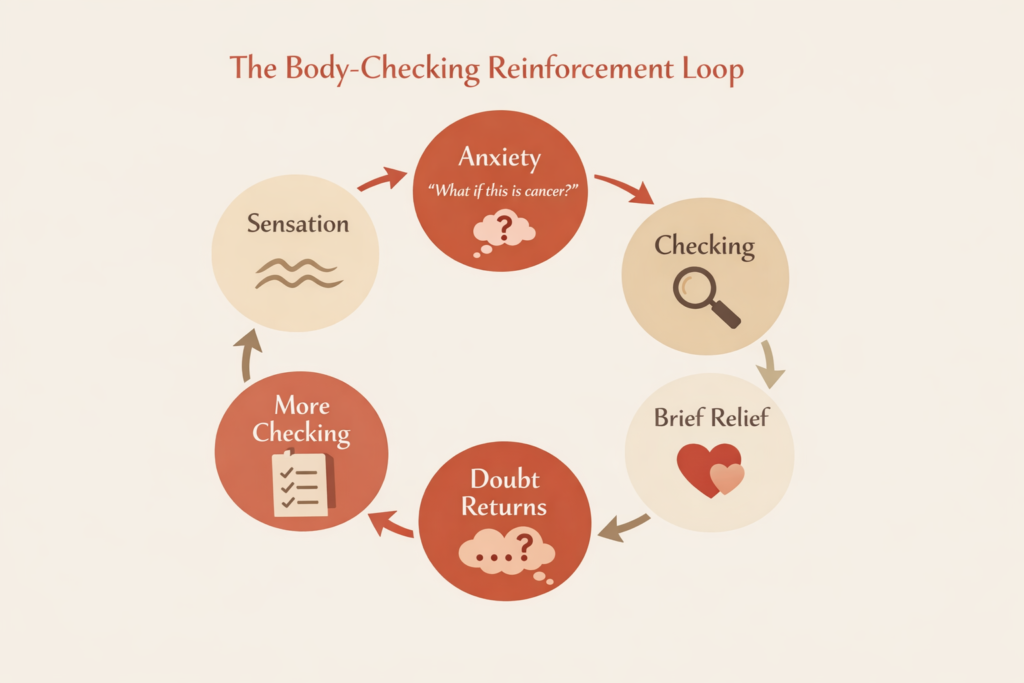
The body-checking reinforcement loop:
1. You notice a sensation (a lump, a pain, a change)
2. Anxiety rises: what if this is cancer?
3. You check — pressing, prodding, examining
4. You feel brief relief: it seems okay, nothing has changed
5. The relief fades. Doubt returns: but what if I missed something?
6. You check again Each cycle strengthens the loop. The relief is real but short-lived. The doubt always returns.
This is a pattern psychologists call negative reinforcement. The checking temporarily removes the anxiety, which makes the behaviour feel necessary and effective. But because the underlying uncertainty has not been resolved — because it cannot be resolved through checking — the anxiety returns, often stronger than before. Over time, the threshold for checking drops: smaller and smaller sensations trigger the cycle, and the checking becomes more frequent, not less.
This is the same mechanism that drives reassurance seeking in other anxiety-related patterns after cancer. Whether you are checking your body, Googling symptoms at 2am, or asking your partner to feel a spot on your neck, the structure is the same: a brief reduction in anxiety that paradoxically feeds the cycle.
What checking does to your relationship with your body
Beyond the anxiety cycle itself, repeated body checking changes how you experience your own body. When you check the same area over and over, you create tenderness and irritation. The tissue becomes sore from prodding. This soreness then becomes a new source of alarm — something that feels different, something that was not there before — which triggers more checking.
There is also a subtler cost. Body checking keeps you in a relationship with your body that is defined by surveillance, not by inhabiting. Your body becomes something to monitor, not something to live in. The ordinary pleasures of physical experience — warmth, movement, rest, touch — get displaced by a constant background hum of vigilance. You may find that you have lost the ability to simply be in your body without simultaneously scanning it.
This is one of the quieter costs of cancer that many survivors recognise but rarely name. It is not just the fear of recurrence. It is the loss of being at home in your own skin.
How to begin stepping out of the checking loop
The first and most important thing to understand is that the solution to body checking is not to stop paying attention to your body. That would be another form of avoidance, and it does not work any better than the checking does. The goal is to change the relationship between noticing a sensation and what you do next.
Evidence-based psychological approaches for fear of cancer recurrence — particularly Acceptance and Commitment Therapy (ACT) — work with this pattern directly. Rather than trying to stop the fear or suppress the urge to check, ACT helps you develop a different response to the moment of uncertainty (Tauber et al., 2019). The aim is not to eliminate the sensation or the thought. It is to notice them without automatically acting on them.
Some of the principles that underpin this approach:
Notice the urge, not just the sensation. When you feel the pull to check, pause and observe the urge itself. What does it feel like? Where is it in your body? What is it asking you to do? Noticing the urge is different from acting on it.
Name what is happening. Saying to yourself — silently or aloud — “My threat detection system is responding to a sensation” can create a small but meaningful gap between the trigger and the habitual response.
Allow the uncertainty. This is the hardest part. The urge to check is an urge to resolve uncertainty, but the uncertainty of life after cancer cannot be resolved through checking. Allowing the discomfort of not knowing, even for a few minutes, begins to weaken the loop.
Redirect toward what matters. After noticing the urge and allowing the uncertainty, gently redirect your attention toward whatever you were doing or whatever matters to you in that moment. Not as a distraction, but as a choice about where you want your attention to be.
These are not quick fixes. They are skills that develop over time, often with the support of a psychologist who understands the specific patterns of fear after cancer. But they are effective — research consistently shows that ACT-based interventions reduce both the intensity of FCR and the behaviours that maintain it, including body checking (Tauber et al., 2019; Yuyan et al., 2025).
When body checking needs professional support
Body checking exists on a spectrum. At one end, it is an occasional, minor habit that surfaces around scan appointments or when you are stressed. At the other end, it is a daily, time-consuming pattern that causes distress, interferes with your work and relationships, and has become difficult to control even when you recognise what you are doing.
If your checking has become frequent, distressing, or feels compulsive — if you find yourself unable to stop even when you want to — it is worth speaking with a psychologist who specialises in fear of cancer recurrence. This is not a sign of failure. It is a sign that the pattern has become self-reinforcing and that your own efforts to manage it are no longer enough.
Specialised psychological support can help you understand the specific version of the checking loop that has developed for you, identify the triggers that set it off, and build a different response — one that does not depend on achieving certainty about your body.
If you want to start making sense of this pattern
Body checking is one of the ways fear of cancer recurrence keeps itself going. Understanding the loop is the first step toward stepping out of it. If you want to begin exploring your own experience of fear after cancer, my free guide, “When the Fear Doesn’t Leave,” is a good place to start. It will not fix the checking — but it will help you understand what is driving it and what a different relationship with fear might look like.
If you are ready to go deeper, The Fear That Stays explores the patterns that maintain fear after cancer — including body checking, reassurance seeking, and avoidance — and helps you begin mapping your own experience.
Frequently asked questions
Is body checking after cancer normal?
Yes. Body checking is one of the most common responses to cancer and is reported by a large proportion of cancer survivors. It is driven by the brain’s threat detection system, which remains in a heightened state after a real experience of danger. While it is normal, it can become distressing and self-reinforcing if it develops into a frequent pattern.
How is body checking different from self-examination?
Self-examination is a planned, proportionate health behaviour — checking at recommended intervals, for recommended signs, with a clear endpoint. Body checking is driven by anxiety rather than information: it happens repeatedly, often automatically, and does not produce lasting reassurance. The difference is not in the physical action but in what drives it and whether it ends.
Can body checking cause physical symptoms?
Yes. Repeated pressing, prodding, or palpating the same area can cause tenderness, swelling, and irritation. These physical changes can then become new sources of anxiety, triggering further checking. This is one of the ways the cycle can escalate.
What should I do if I cannot stop checking?
If body checking has become frequent, distressing, or difficult to control, consider working with a psychologist who specialises in fear of cancer recurrence. Specialised psychological support — particularly ACT-based approaches — can help you develop a different response to the urge to check, without relying on willpower alone.
About the author
Nina Tauber is a clinical psychologist with a PhD in psycho-oncology, specialising in fear of cancer recurrence. She developed manual-based FCR treatments at Aarhus University and Aarhus University Hospital, in collaboration with international partners. Her approach is evidence-based and grounded in the understanding that fear after cancer is a natural response — not a disorder to be fixed, but an experience to be understood and worked with. She works with cancer survivors and their loved ones, online, from wherever they are in the world.

References mentioned in this article
Luigjes-Huizer YL, Tauber NM, Humphris G, et al. What is the prevalence of fear of cancer recurrence in cancer survivors and patients? A systematic review and individual participant data meta-analysis. Psycho-Oncology. 2022;31(6):879–892.
Tauber NM, O’Toole MS, Dinkel A, et al. Effect of psychological intervention on fear of cancer recurrence: A systematic review and meta-analysis. Journal of Clinical Oncology. 2019;37(31):2899–2915.
Yuyan L, et al. Acceptance and Commitment Therapy for fear of cancer recurrence: A systematic review and meta-analysis. European Journal of Oncology Nursing. 2025;76:102862.
Butow PN, Turner J, Gilchrist J, et al. Randomized trial of ConquerFear: A novel, theoretically based psychosocial intervention for fear of cancer recurrence. Journal of Clinical Oncology. 2017;35(36):4066–4077.
Lee-Jones C, Humphris G, Dixon R, Bebbington Hatcher M. Fear of cancer recurrence—A literature review and proposed cognitive formulation to explain exacerbation of recurrence fears. Psycho-Oncology. 1997;6(2):95–105.
Wells A, Matthews G. Attention and Emotion: A Clinical Perspective. Lawrence Erlbaum Associates; 1994.
Tauber NM, O’Toole MS, Jensen AB, et al. ConquerFear-Group: A Randomized Controlled Trial of an Online-Delivered Group-Based Psychological Intervention for Fear of Cancer Recurrence in Breast Cancer Survivors. Psycho-Oncology. 2023;32(9):1424–1432.
Blog
This section offers a summary of the blog, presenting a range of articles, perspectives, and materials to educate and motivate readers.
-
How Fear of Cancer Recurrence Shows Up Differently for Different People
Fear of cancer recurrence is often spoken about as though it were one uniform experience,…
-
Fear of Cancer Recurrence on a Continuum – From Natural, Adaptive Response to Debilitating Fear
Fear of cancer recurrence exists on a continuum. At one end, it is a natural,…
-
Why Your Body No Longer Feels Neutral After Cancer
After cancer, ordinary bodily sensations — a headache, fatigue, a twinge in the side —…

Leave a Reply